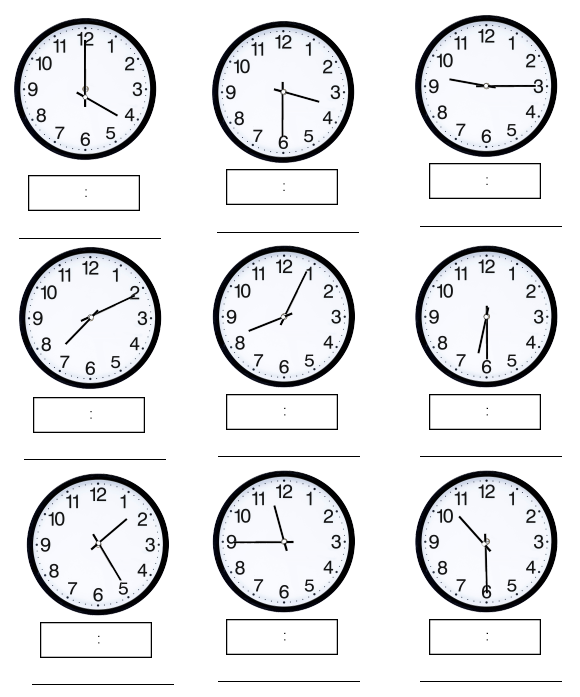
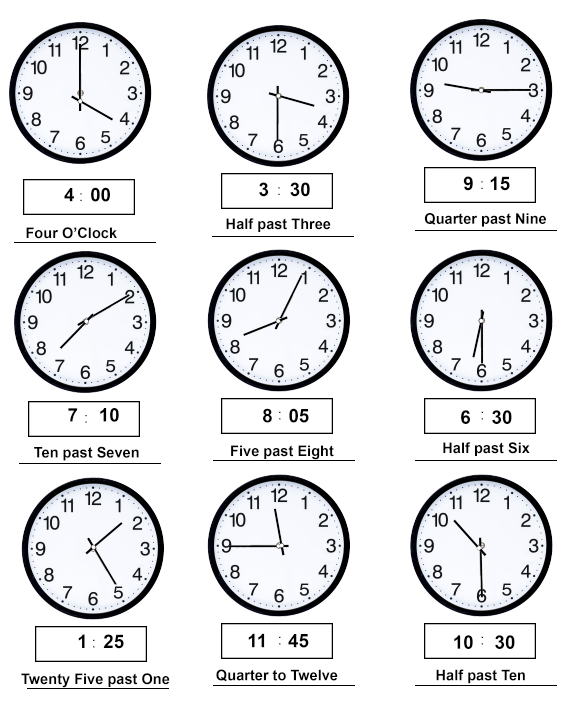
About These Class 4 Time and Calendar Worksheets
Learning to read clocks and calendars is one of the most practical maths skills a child can develop.
These Class 4 time and calendar worksheets are designed to build that confidence step by step,
moving from basic clock reading all the way to multi-step elapsed time problems and calendar word problems.
Every worksheet on time and calendar for Grade 4 is printable, completely free,
and comes with a full answer key — making them ideal for classroom use, homework, or extra practice at home.
The content is aligned with the standard Class 4 maths curriculum (CBSE, ICSE, and international syllabi).
📌 Teacher & Parent tip
Start with the analog clock sections before moving to 24-hour conversion. Students who struggle with elapsed time often benefit from drawing a number-line timeline between the start and end time before calculating.
Whether your child needs help with the 24-hour clock, understanding the difference between a.m. and p.m.,
or solving elapsed time word problems, these free printable time worksheets for Class 4
provide structured, graded practice across all topics.
Frequently asked questions
Time & Calendar Worksheets — Class 4 FAQs
Common questions from parents and teachers about these free Class 4 maths worksheets.
What topics are covered in Class 4 time and calendar worksheets?
▾
These worksheets cover: telling time on analog and digital clocks, a.m. and p.m., 24-hour time notation (and conversion), time unit conversions (seconds, minutes, hours, days), addition and subtraction of time, elapsed time word problems, reading monthly calendars, identifying days and dates, and calendar word problems. All topics are standard in the Class 4 maths curriculum.
Are these Class 4 time worksheets free to download?
▾
Yes — all worksheets on Superior Scholar are completely free. No sign-up, no email, no payment. Click the download button and you get the PDF instantly. You can print as many copies as you need for home or classroom use.
Do these worksheets include answer keys?
▾
Yes. Every worksheet comes with a complete answer key. You can also see the answers inline on this page (scroll to the green "Answer Key" box in the sample worksheet above). This makes it easy for parents and teachers to check work without having to solve each question themselves.
How do I convert 12-hour time to 24-hour time?
▾
The rule is simple: for a.m. times, keep the hour the same (except 12:00 a.m. midnight = 00:00). For p.m. times, add 12 to the hour — so 1:00 p.m. becomes 13:00, and 6:30 p.m. becomes 18:30. Noon (12:00 p.m.) stays as 12:00. This conversion is used in train timetables, flight schedules, and 24-hour clocks.
What is elapsed time and how is it calculated?
▾
Elapsed time is the amount of time that has passed between a start time and an end time. To calculate it, you can subtract the start time from the end time. For example: a movie starts at 3:00 p.m. and ends at 5:15 p.m. — the elapsed time is 2 hours 15 minutes. A helpful strategy is to draw a number line and "jump" from the start time to the end time in easy steps (e.g., count up to the next hour first, then count remaining minutes).
Which months have 31 days? (Easy trick to remember)
▾
The months with 31 days are: January, March, May, July, August, October, and December. An easy way to remember: use the knuckle method. Hold up a fist and count knuckles (= 31 days) and gaps (= 30 days, or 28/29 for February) starting from the index finger. January = first knuckle (31), February = first gap (28/29), March = second knuckle (31), and so on.
Are these worksheets suitable for CBSE, ICSE, and other boards?
▾
Yes. The topics covered — telling time, 24-hour clock, time conversions, elapsed time, and calendar skills — are part of the standard Class 4 maths curriculum across CBSE, ICSE, state boards, and most international curricula. The worksheets are content-based rather than board-specific, making them useful across all systems.