Download Free Grade 1 Number Worksheets


More Grade 1 Maths Topics
Explore Numbers Worksheets by Grade
Class 1 numbers 1–100 worksheets help children practise counting, reading, writing and ordering numbers. This free collection includes printable PDF activities for counting to 100, filling in missing numbers, finding the number before and after, ordering numbers, writing number names and practising skip counting.
📋 On This Page
What Do Grade 1 Students Learn About Numbers to 100?
Working with numbers up to 100 builds early number sense. Grade 1 learners commonly practise counting forward and backward, recognizing two-digit numbers, placing numbers in order, identifying numbers before and after a given number, reading number names and noticing simple counting patterns.
- Count and read numbers from 1 to 100.
- Write numerals and number names for familiar numbers.
- Find missing numbers in a sequence or number line.
- Identify before, after and between relationships.
- Order numbers from smallest to greatest or greatest to smallest.
- Use skip counting by 2, 5 and 10 to recognize patterns.
Numbers 1 to 100 Chart
Use this simple 1–100 number chart for quick counting practice, number recognition and sequencing. Ask the learner to point to a number, find the next number, or identify a number that comes before or after it.
Tip: Cover a few numbers with a piece of paper and ask the child to say which numbers are missing.
Counting 1–100 Practice
Counting worksheets give children repeated practice with number order. Start with smaller ranges and gradually work toward 100. The printable PDFs below can be used for classroom work, homework or extra practice at home.
- Count forward: 21, 22, 23, ___, ___
- Count backward: 60, 59, ___, ___, 56
- Complete the sequence: 37, ___, 39, ___, 41
- Start at 72 and count forward to 80.
Missing Numbers Worksheet Practice
Missing-number activities help children understand that numbers have a fixed order. They also provide useful practice for recognizing patterns without simply memorizing a list.
- 1, 2, ___, 4, 5, ___, 7
- 18, ___, 20, 21, ___, 23
- ___, 46, 47, ___, 49, 50
- 68, 69, ___, 71, ___, 73
- 95, ___, 97, ___, 99, 100
Before, After and Between Numbers
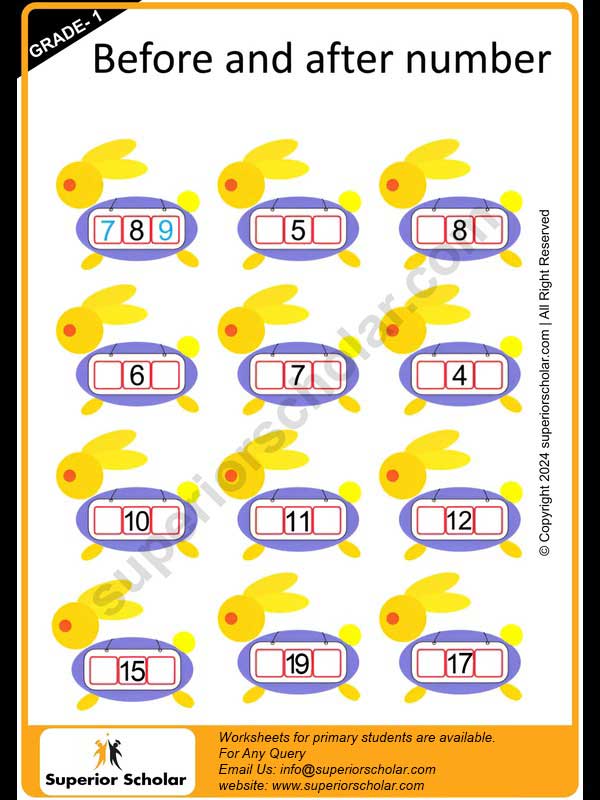
Learning what comes before, after and between numbers is an important sequencing skill for Grade 1. These questions can be solved using the 1–100 chart above or by counting forward and backward.
- What comes before 30? ___
- What comes after 47? ___
- What number is between 63 and 65? ___
- What comes before 100? ___
- What comes after 89? ___
Ordering and Comparing Numbers
Children should be able to arrange numbers from smallest to greatest and from greatest to smallest. Comparing numbers also prepares them for later addition, subtraction and place-value work.
- Arrange from smallest to greatest: 18, 7, 24, 12.
- Arrange from greatest to smallest: 35, 52, 41, 29.
- Which is greater: 67 or 76?
- Which is smaller: 43 or 34?
- Fill in >, < or = : 58 ___ 58.
Number Names 1–100
Reading and writing number names connects a numeral with the way we say it. Practise both directions: read a number name and write the numeral, or read a numeral and write the number name.
- 12 → __________
- 27 → __________
- 40 → __________
- 58 → __________
- 100 → __________
Practice words: twelve, twenty-seven, forty, fifty-eight, one hundred.
For more practice, download the free number-names worksheets in the PDF section below.
Skip Counting by 2, 5 and 10
Skip counting helps children recognize repeated number patterns and supports later work with multiplication. Use short sequences first, then extend them toward 100.
- By 2: 2, 4, 6, ___, ___, 12
- By 5: 5, 10, 15, ___, ___, 30
- By 10: 10, 20, 30, ___, ___, 60
Free Printable Grade 1 Numbers 1–100 PDF Worksheets
Download and print the existing Superior Scholar worksheets for focused practice. Each link opens the corresponding PDF file.
How to Use These Number Worksheets
- Choose one worksheet that matches the skill your child is practising.
- Let the child solve the questions independently before giving help.
- Use the 1–100 chart on this page when a child needs a visual number reference.
- Review mistakes by asking the child to count forward or backward rather than simply giving the answer.
- Repeat a different worksheet later to build fluency.
For a broader Grade 1 maths practice set, continue with addition worksheets, subtraction worksheets, comparison worksheets and skip counting worksheets.
Frequently Asked Questions About Grade 1 Numbers 1–100 Worksheets
What are numbers up to 100 worksheets for Grade 1?
They are practice worksheets that help Grade 1 students count, read, write, order and recognize numbers from 1 to 100. Activities may include missing numbers, before and after, number names and simple patterns.
What skills do children practise with numbers 1–100?
Common skills include counting forward and backward, recognizing two-digit numbers, completing number sequences, finding numbers before and after, ordering numbers, reading number names and skip counting.
Are these Grade 1 number worksheets free to print?
Yes. The worksheet PDF links on this page point to free printable resources hosted on Superior Scholar.
How can I teach numbers 1 to 100 at home?
Use a 1–100 number chart, practise short counting sequences, ask for missing numbers, and mix counting with number-name and ordering activities. Short, repeated practice is useful for building fluency.
What should a Grade 1 child know about numbers to 100?
A child should be developing confidence in counting and reading numbers to 100, recognizing number order, finding numbers before and after, and working with simple patterns and number names.
Can these worksheets be used for classroom and homework practice?
Yes. The printable PDFs can be used for classroom practice, homework, revision or extra practice at home.